
Best practise: This is how denim stays beautiful for a long time!
- Washing recommendations for prewashed denim (everyday care)
- Special tips for raw denim (the first wash)
- Vinegar bath for colour fixing
- FAQ ‐ Frequently asked questions
Denim fabrics are more than just a material – they tell stories. With every wear and with whatever each person carries in their pockets day by day, denim develops into a unique piece. This personal pattern, known as patina, develops particularly beautifully on dark blue denim.
Denim fabrics should be washed before use or cutting. This removes excess dye, finishing agents, and allows the fabric to reach its final size.
To ensure your denim stays beautiful and in good condition for a long time, I’m happy to share my best care tips with you as a denim expert.
⚠️ Important Note: Manufacturer Recommendations vs. Expert Tips
The manufacturer's care instructions are very general washing guidelines. Please note: These manufacturer specifications merely state which processes the fibre can purely technically withstand without damage. However, they take absolutely no account of preserving the intensive colour depth or preventing washing streaks!
Anyone who washes deep blue, black, and/or unwashed denim according to these standard specifications is almost guaranteed to end up with light streaks in the fabric. My care tips are based on years of practical experience and show you how to prepare the denim gently so that its premium look is perfectly preserved. For optimal results, please feel free to follow my proven recommendations!
1. Washing recommendations for denim fabrics (everyday care)
 | Wash at 30 °C on a shortened gentle cycle – protects colour and fibres. |
 | No bleach – prevents colour loss. |
 | Do not use fabric softener – helps maintain the elasticity of stretch denim. |
 | Spin gently at 400 rpm – reduces the risk of wash creases. |
 | Dry flat – preserves shape and colour. |
- Denim fabrics should be washed before use or cutting, even if they are pre-washed. This removes excess dye, finishing agents, etc., allows the fabric to reach its final size, and makes it softer. Denim typically shrinks by around one to five percent.
- To keep the washing process as gentle as possible, denim should only be washed at 30 °C on a delicate cycle or a gentle short programme. Some washing machines offer special programmes for denim or dark fabrics.
- Use detergent without bleach. For dark blue or black fabrics, a detergent specifically for dark laundry is ideal.
- For denim containing elastane, do not use fabric softener, as it can damage synthetic fibres and cause the fabric to lose its shape.
- To avoid so-called wash creases, the machine should be loosely filled and a low spin speed should be selected (400 to max. 600 rpm).
- After washing, dry the fabric flat. I do not recommend a tumble dryer, as it can cause colour fading.
Note for very dark, deep blue denim fabrics
Even if you purchase these pre-washed, I highly recommend switching from the standard jeans cycle to a gentle, shortened delicates or quick wash cycle even for everyday care, and reducing the spin speed to a maximum of 400 rpm. Spinning too fast presses the heavy fabric into creases against the drum, which can cause the colour to break in the folds and result in lighter streaks.
2. Special Tips for Raw Denim (The First Wash)
Anyone working with genuine, unwashed raw material (raw denim) is holding a living, natural product in their hands. Unlike industrially pre-washed denim fabrics, this material still retains the maximum amount of indigo pigments at the time of purchase.
Upon the very first contact with water (pre-washing before cutting), raw material behaves completely differently: Raw denim bleeds heavily, loses its stiff sizing, and the colour tone changes – it usually only then becomes truly characteristic and more bluish. This is an absolutely natural process and not a quality defect!
To ensure that this first wash does not lead to unwanted, uneven colour loss or light streaks, the rule in the global denim community is: The gentler, the better.
- Method A: The Denim Enthusiasts' Secret – Hand Washing
Many denim enthusiasts swear by never putting raw denim in the machine for its first wash. Instead, lay the fabric by the meter flat and without heavy creasing into a bathtub with lukewarm water (max. 30°C). Add a special denim detergent or a gentle delicates detergent without optical brighteners – regular detergent is often too aggressive for the indigo. This allows only excess pigments to bleed out, while protecting the deep dye within the fibre as much as possible. Afterwards, do not wring out the fabric, but let it air dry flat while dripping wet. - Method B: Wool or Hand Wash Cycle instead of "Jeans Cycle"
If you prefer using the washing machine, please do not select a standard delicates or regular jeans cycle for raw material. These often run too long and agitate the heavy fabric too aggressively. The wool or hand wash cycle operates with a higher water level (the fabric floats and does not rub against itself) and a gentle cradling motion instead of harsh drum rotations. - Colour Protection with Vinegar
During the first wash, I add a generous splash of vinegar essence directly into the detergent compartment of the washing machine. The acid closes the fibers, fixes the indigo pigments, and significantly reduces colour bleeding during the wash. For maximum colour protection, I recommend a vinegar bath. - No or Minimal Spinning
When pre-washing raw material, it is best to set the machine to "rinse hold" (no spin) or a maximum of 400 rpm. Spinning too fast can break the indigo layer in the creases and create unsightly, light streaks (the so-called marbling effect).
3. My denim fabric is bleeding heavily! What can I do?
Dark denim fabrics typically release excess dye at first and may bleed, especially when damp. If a denim fabric releases too much colour, you can easily fix the dye:
To fix the colour, you can soak the fabric before or after sewing in a vinegar bath. Put the fabric into a mixture of approx. 3 l of water, 250 ml of vinegar essence and 150 g of table salt for at least 1 hour, preferably overnight.
Quick alternative: Add a little vinegar essence to the wash along with the detergent.
Vinegar bath recipe for colour fixing
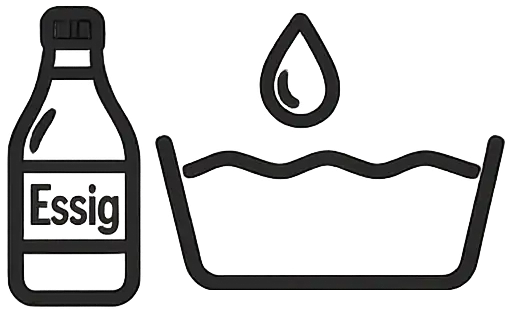 | 3 l water + 250 ml vinegar essence + 150 g salt – soak overnight. |
4. FAQ – Frequently asked questions about denim care
- How often should I wash denim fabrics?
As rarely as possible – airing is often enough. Frequent washing accelerates colour loss and fibre fatigue. - What are “wash creases” and how can I avoid them?
Light streaks caused by folds during spinning – avoid them by loosely filling the machine and using max. 400 rpm. - My fabric is bleeding – is this a defect?
No, this is typical for dark denim and not a quality issue. The colour stabilises over time. - How do I fix the colour before the first wash?
With a vinegar bath: 3 l water + 250 ml vinegar essence + 150 g salt – soak for 1 hour, preferably overnight. - Why wash inside out?
It protects the outer surface, reduces abrasion and helps preserve colour – especially with dark denim. - Why does my raw denim change its colour and feel after the first wash?
This is an absolutely natural process typical of the product and is not a quality defect. Untreated raw material (raw denim) is stiffer in its original state because it still contains the full sizing and excess indigo pigments. Upon first contact with water, these superficial colour pigments dissolve, making the fabric usually slightly lighter, more bluish, and significantly softer. Anyone wishing to preserve this "original look" and colour depth as much as possible should wash the fabric before cutting exclusively by hand or on an extremely gentle wool programme. - What can I do about strong odours?
A vinegar or bicarbonate bath often works better than washing alone. Alternatively: air in a humid environment. - Which detergent is best for denim?
A colour detergent without optical brighteners or bleach – ideally one formulated for dark laundry. - Why shouldn’t I use fabric softener?
It damages elastane, causing stretch denim to lose its shape. It can also wash out colour. - How do I remove stains without damaging the colour?
Treat locally with mild soap or diluted vinegar – dab, don’t rub. - Can I freeze jeans to clean them?
No – that’s a myth. Bacteria survive and odours remain. Washing or airing is more effective.
Discover our denim fabrics – now that you know how to care for them properly:










Discover my denim fashion for men:

I also create one-of-a-kind outfits for men:

MOORE STOFFE © 2026 | Template © 2009-2026 by modified eCommerce Shopsoftware
